
Digital Painting Tutorial: The Making of Downtown Frogtown
Concept Artist and Cubebrush seller Jourdan Tuffan shows us the creation of 'Downtown Frogtown,' an environment that landed him as a finalist in the Worlds Challenge.
I’d like to start by thanking Cubebrush for hosting this contest, and giving me the opportunity to share the creation process of my entry!
IDEATION
When I first read the brief for the contest, there were a few considerations that I thought are important to keep in mind as I work on my piece. Since the basic idea is to create a new civilization built atop an old one, I think that they should both strongly contrast against one another., and would give the image the biggest impact and clarity. With that in mind, I had decided to do a juxtaposition of fantastical and more sci-fi/modern elements.
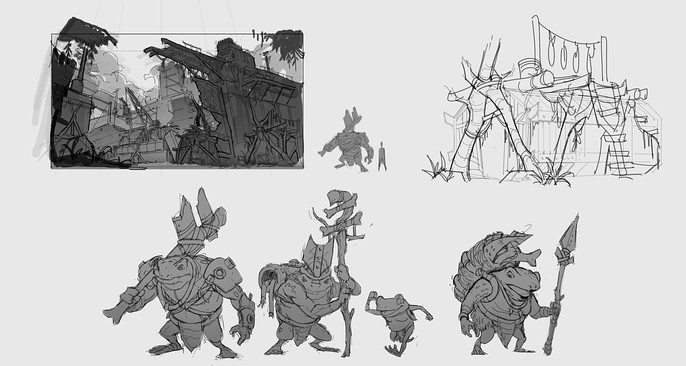
I had done a lot of rough sketches at this stage, with a focus on ideas, and rounded them down to these two ideas.

1) A tribe of bird riders flee from their home land, finding refuge in caverns, where they find the remnants of an ancient, yet advanced civilization.
2) A colony of Frog Ogres (Frogres) finding the husk of a fallen mech upstream, and build their habitat from its various parts.
I ended up going with the second idea, as I have a soft spot for ogres, and I anticipated that the first one would be more challenging to execute.
FURTHER EXPLORATION
As I did further explorations for the idea, I found it difficult to design a home out of the husk of the giant mech, without it looking too contrived or repeating existing solutions from other artists. I decided to change the remnant of the old civilization from a mech to an abandoned shipyard. I liked the idea of being able to use ships, cargo container, or whatever machinery or wreckage is lying around being re-purposed as new habitats. Now that I have decided on an idea, I quickly sketch out the denizens of the colony, and potential architecture. To get the idea out as soon as I can, and to give a starting point and enrich the vision of the world in my mind.
FINDING THE RIGHT SHOT
The next step was to create more explorations for the composition. I tried out a few different workflows and for this particular set I started off by modeling a quick blockout in MODO. I rendered out a couple of different shots and laid in some quick silhouettes using a hard round brush (with full opacity, and a ‘stroke’ set as a layer style on it). This allowed me to design without getting bogged down by details and to focus on the bigger shapes.
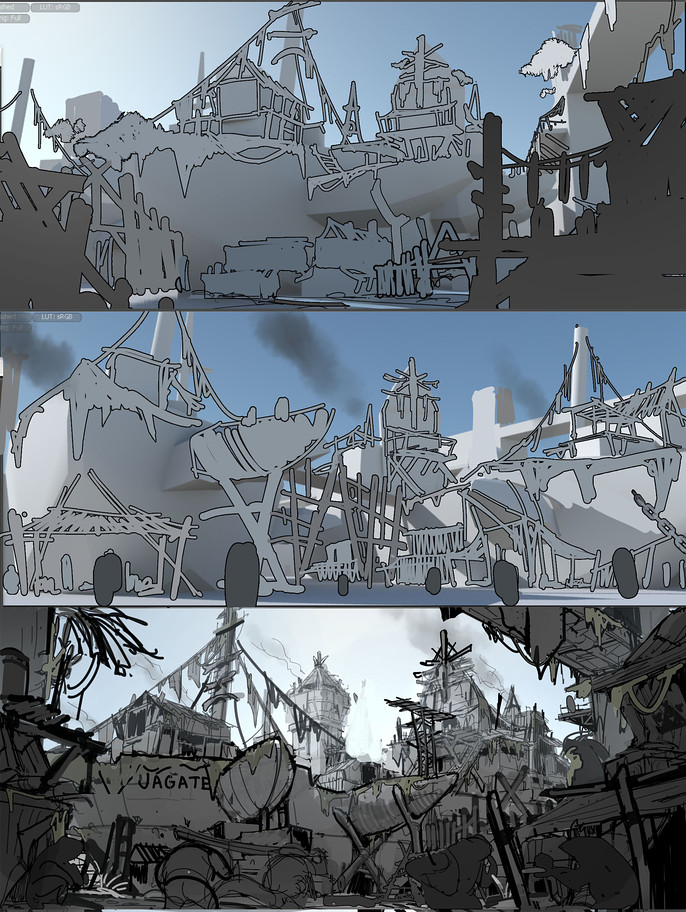
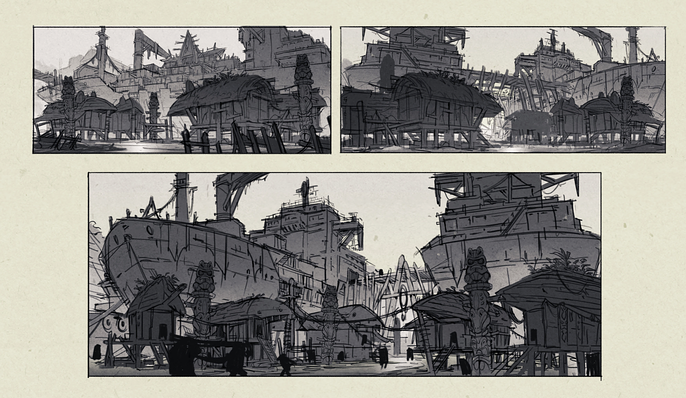
I wasn’t quite happy with these rounds of explorations at the time as I felt that they had lost a feeling of a small and intimate village setting and ended up looking more like a fortress. I went back to the drawing board and did a new set of explorations with good old linework. I feel it gives me more control this way. As a result, I am not as tempted to remain restricted by what the blockout has given me, not to mention being much faster to go through different solutions.
Narrowing the Focus
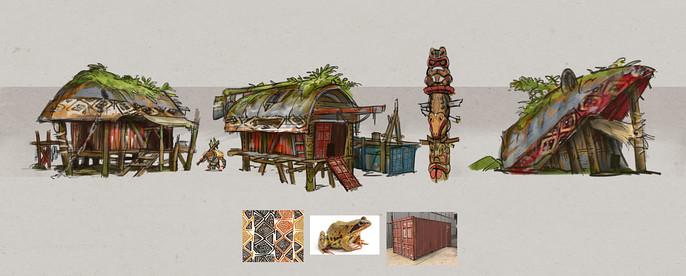
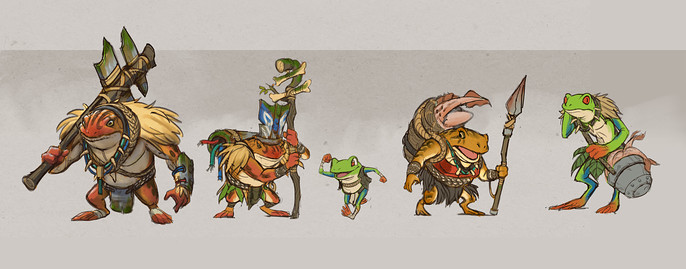
After arriving at a composition that I was more satisfied with, I wanted to narrow my focus down and further resolve the design of the bits and pieces of the environment.
I find that breaking a more complex piece down to its simpler parts can help you from getting overwhelmed and give you more confidence as you jump into the final piece. It also makes it much easier to expose any problems in your individual designs and address them as early as you can.
I redesigned the architecture to resemble Torajan Houses which tethers the design to reality, makes it more recognizable as a living area and is more practical. To tie things back to the original idea, I had the walls of the house built out of shipping containers and used the conveniently sloped ship hulls as roofs. I added in some wooden stilts to add a tribal flavor and to not over-saturate the design with man-made elements. Adding some foliage and moss caking the structures also helped with that and introduces a nice color accent too.
SETTING THE MOOD
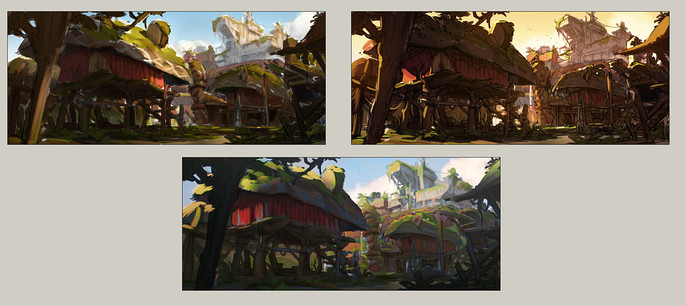
With the smaller parts of the piece resolved, I was able to refine one of the rougher sketches and start to harmonize them. I had to forego some of the designs I had done in favor of keeping the composition from the sketch intact.
After refining the rough sketch the next phase was to figure out the mood and lighting. I wanted to go for a feeling of grand discovery and I think that a golden hour type of lighting would work best. However, I still ended up doing 3 options in total, just to exhaust the possibilities. It usually ends up with two possibilities; being pleasantly surprised by a newer solution, or being certain that my initial idea works best. My initial thought was to design the lighting to emphasize the focal point of the dominant hut in the piece, so the first one I did ended up being the one I went forward with.
CROSSING THE FINISH LINE
The refining stage posed a huge challenge for me. Before I had decided to join this contest, I had not done a piece on this scale; a full environment and characters occupying it. I primarily struggled to nail the lighting and mood and making sure that all of the elements read clearly. In hindsight (and many attempts and feedback from peers later), I realized that the best way to tackle a larger piece is to work from the focal point and address problems as they come. I tried to address too many problems at once, and it left me constantly doubting myself. However, the moment I started to work from a focal point and focusing on one aspect at a time it became much more manageable.
I also decided to add the frogs a bit later in. I found myself having the problem of gelling them in with the rest of the environment and I even found that I had to redesign the lighting scenario to make sure they did not interrupt the overall composition/read. I experimented with their placement, how light interacted with them and varying the size and depth of them on the canvas until it felt right.
I found that it is also alright to add in extra details after establishing the major forms. Details such as the foliage and hanging fish and pots and ropes tied around logs tend to affect the overall composition/read too much and can often add complexity and problems when starting off. With an already solid foundation of major forms, lighting, and colors done, it was much easier to layer and add more details on top of it.
Jourdan Tuffman's entry can be found here.